

From the Mother College, Change Begins: Baghdad Medicine Charts a New Course for Mental Health
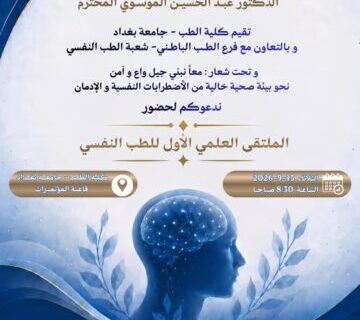
The College of Medicine at the University of Baghdad launched the activities of the First Scientific Forum on Psychiatry on Tuesday, September 15, 2026. The event was attended by Prof. Dr. Haider Abdul-Dhahad, Deputy Minister of Higher Education and Scientific Research for Scientific Research Affairs; Dr. Hassan Mohammed Abbas Al-Tamimi, Director General of the Medical City Department; as well as a number of distinguished academic and medical figures and a select group of professors, researchers, and students.
The forum commenced with an opening address delivered by the Assistant Dean for Scientific Affairs, Prof. Dr. Mohammed Basil, who welcomed the attendees and emphasized that the organization of the forum forms part of the College of Medicine’s commitment to strengthening scientific activities addressing health issues directly relevant to individuals and society. He also highlighted the importance of expanding academic dialogue on mental health and its growing challenges.
In his address, the Deputy Minister for Scientific Research Affairs, Prof. Dr. Haider Abdul-Dhahad, commended the historic and scientific standing of the College of Medicine, University of Baghdad, describing it as the “mother college” with a distinguished heritage and an outstanding present. He also highlighted the significant qualitative development witnessed by the College under the leadership of its Dean, Prof. Dr. Ameen Abdul-Hassan Manea Al-Alwany, particularly in the areas of medical education and the advancement of the academic and scientific environment.
Abdul-Dhahad addressed the major difficulties and challenges facing medical education and discussed possible approaches to addressing them. He also announced the launch of a Psychological Counseling Guide for University Students, prepared under the supervision of a group of psychiatrists and with follow-up by the Ministry of Higher Education and Scientific Research. The initiative aims to provide a scientific and professional framework for supporting students and helping them cope with the psychological pressures and challenges they may encounter throughout their university studies.
He further emphasized the Ministry’s efforts to advance scientific research and enhance the quality of research publications in medical specialties. He revealed plans to establish a research-oriented Medical Doctorate (Medical Doctorate) pathway, which would enable board-certified trainees to pursue the degree concurrently with their training period without requiring full-time academic leave. The initiative is expected to be piloted at a number of medical colleges, with the College of Medicine at the University of Baghdad taking a leading role as the mother college and a pioneering institution in Iraqi medical education.
For his part, the Dean of the College of Medicine, University of Baghdad, Prof. Dr. Ameen Abdul-Hassan Manea Al-Alwany, stated in his address that some of the most painful forms of suffering are those carried silently by individuals and remain undetected by imaging or laboratory tests. He stressed the need to approach mental health with the same seriousness and openness applied to physical illnesses, emphasizing that seeking psychological assistance is an informed and courageous act and an essential step toward treatment and recovery.
Al-Alwany explained that the danger posed by mental disorders lies not only in the illness itself, but also in the social stigma, misconceptions, and fear that may prevent patients from seeking help. He emphasized that the responsibility of medical institutions extends beyond diagnosis and treatment to include correcting public perceptions, promoting a culture of support and inclusion, and defending patients’ right to care, dignity, respect, and social integration.
He also expressed his appreciation to the official and scientific figures and participating professors, commending the efforts of the Department of Internal Medicine and the Division of Psychiatry in organizing the scientific event. He further extended his gratitude to the Medical City Department, described as the “twin sister” of Baghdad Medicine, for its longstanding support of the College’s students and for providing them with a clinical training environment, recognizing its continued cooperation and established partnership in supporting medical education and advancing healthcare services.
The opening session also featured an address by the Head of the Department of Internal Medicine, Prof. Dr. Moataz Fawzi, who provided a historical overview of the department’s development and milestones. He highlighted the establishment of the Division of Psychiatry and its role in education, training, and medical services, as well as its growing scientific and academic presence within the College.
In turn, the Head of the Division of Psychiatry within the Department of Internal Medicine, Prof. Dr. Mushtaq Talib Hashim, began his address by stating: “When life becomes overwhelming for a person, they need someone who understands them and their suffering before judging them. Mental illness may not be visible, but it requires someone who can recognize and empathize with it.”
Hashim highlighted the increasing psychological challenges facing Iraqi society, including addiction, suicide, and the social stigma associated with mental disorders. He emphasized the importance of building public awareness that recognizes seeking psychological assistance as a natural right rather than a source of shame or social isolation.
He also praised the substantial support provided to the Division of Psychiatry by the College’s administration, represented by its Dean, Prof. Dr. Ameen Al-Alwany. He noted that psychiatry had not previously received attention commensurate with its importance, whereas the current College administration has demonstrated clear interest in the specialty and contributed to strengthening its scientific and academic presence while supporting its activities and programs.
This was followed by an address from Prof. Dr. Naseef Jasim Al-Humairi, who discussed the significance of psychiatry and its central position within an integrated healthcare system. He highlighted its role in prevention, diagnosis, treatment, and patient rehabilitation, stressing the need to support specialized training programs, develop physicians’ competencies, and strengthen scientific research in the fields of mental health and addiction.
The opening ceremony also included the honoring of a number of distinguished figures and professors in recognition of their scientific and professional contributions and their efforts to support the field of psychiatry and advance mental healthcare services. The forum subsequently continued with a series of scientific lectures and discussions addressing the major psychological challenges confronting individuals and society and exploring ways to advance awareness, prevention, and specialized care.
The First Scientific Forum on Psychiatry represents a new step in the ongoing journey of Baghdad Medicine, reaffirming that the education of a physician is not complete through clinical knowledge alone, but also requires the ability to understand the human being in both body and mind. It further underscores that attention to mental health is an essential pillar in shaping a future that is more aware, safer, and healthier.